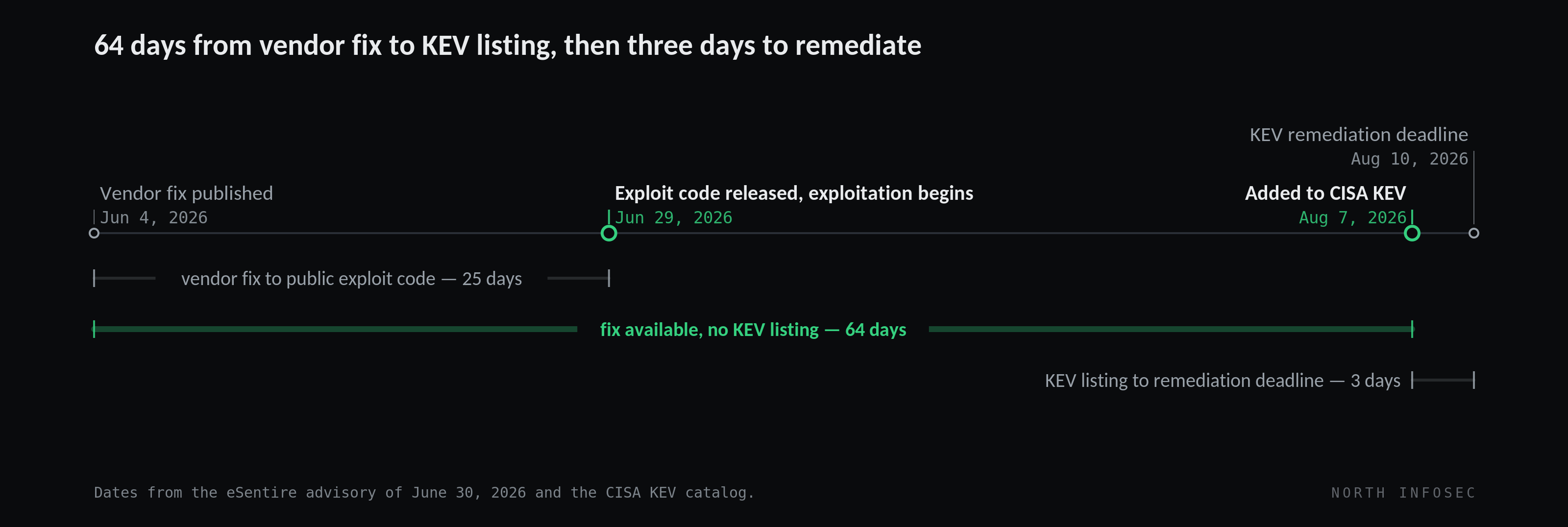
CISA added CVE-2026-8037, an unauthenticated command injection in Progress Kemp LoadMaster, to the Known Exploited Vulnerabilities catalog on August 7, 2026, with a remediation due date of August 10. Three days. Progress had shipped the fix on June 4 — the Canadian Centre for Cyber Security records the vendor advisories as published between June 2 and 4, 2026.
Three days is not a judgment about how bad this particular bug is. It is the output of Binding Operational Directive 26-04, which CISA issued on June 10, 2026 and which, in FedRAMP's summary of it, "reprioritizes vulnerability remediation based on public exposure, Known Exploited Vulnerability status, automatability, and technical impact." CVSS is not one of the four.
The deadline really did move
Days from dateAdded to dueDate in the KEV catalog, by month added, from catalog version 2026.08.11:
| Month added | Entries | Median deadline | Share at 3 days or fewer |
|---|---|---|---|
| 2025-10 | 31 | 21 days | 0% |
| 2026-02 | 28 | 21 days | 21% |
| 2026-03 | 26 | 14 days | 19% |
| 2026-05 | 21 | 14 days | 33% |
| 2026-06 | 23 | 3 days | 74% |
| 2026-07 | 26 | 3 days | 85% |
| 2026-08 | 9 | 3 days | 89% |
The step lands in the month the directive issued. The remaining 14-day and 60-day entries are the middle tiers, not noise. One thing to be precise about: the directive binds federal civilian agencies, not you, and those agencies have until December 7, 2026 to be operating to these timelines. The dates in the catalog moved first.
What the four variables actually ask
Take CVE-2026-8037 through them. Public exposure: LoadMaster sits at the network edge by function. KEV status: listed August 7. Technical impact: CVSS 9.6, unauthenticated remote code execution as root. Automatability: functional proof-of-concept code was published on June 29, and eSentire's Threat Response Unit identified exploitation attempts beginning the same day. Four for four, so tier one.
Now the part that decides whether it is your emergency. The bug is in escape_quotes(), which allocates a heap buffer with malloc() and fails to null-terminate the escaped string, so an out-of-bounds read pulls adjacent heap memory into a shell command that gets executed by system(). It is reachable through the /accessv2 endpoint when the API is enabled. If your API is off, or /accessv2 is not reachable from where an attacker sits, the first variable fails and this is not a three-day item on your estate.
That distinction is a configuration fact you already own. It is also the one nobody can produce in three days under pressure.
The practice: answer the four questions before the clock starts
Build the answers as a standing table, not an incident task. For every internet-facing appliance — load balancers, VPN concentrators, ADCs, file transfer, hypervisor management — record four things: whether its management or API surface is enabled, what can route to it, who approves a maintenance window on it, and how long that approval historically takes.
The last column is the one that turns this from paperwork into planning. A three-day deadline is not a patching problem; patching a LoadMaster is a ten-minute job. It is a change-approval problem on a device sitting in the traffic path, where the downstream service owner has to agree to an outage. If that approval takes eleven days at your company, you do not have a three-day capability and no amount of urgency will produce one.
The cost is honest and small: a couple of days to build the table, and then someone has to keep it current as appliances change, which is the part that decays. The version that survives is a standing monthly maintenance window already on the calendar for edge devices specifically, so the decision is made once a year rather than argued once per CVE. Buying that window is a political cost paid in advance instead of during an incident, which is the only time it is cheap.
When you cannot patch inside the window, remove the reachability instead. For this CVE that is literal: disabling the API, or restricting /accessv2 to a management network, drops the exposure variable and takes the appliance out of tier one without touching the firmware. Most edge appliances have an equivalent lever, and it is usually faster to pull than a firmware update is to schedule. It is weaker than patching and it is far better than a ticket that ages while a proof-of-concept circulates.
One caution the LoadMaster case makes concrete. The 64 days between Progress shipping the fix on June 4 and CISA listing it on August 7 were the window that mattered, and nothing was telling anyone to hurry during them. KEV is a floor. A vendor fix that names no CVE will not appear on it at all.
What to check this week
- List your internet-facing appliances. For each, is the management or API interface enabled, and what can reach it?
- For any LoadMaster: are you on GA 7.2.63.2 or LTSF 7.2.54.18 or later, and is the API enabled?
- Per appliance, who approves a maintenance window and how many days did the last one take? Write the number down.
- Does your patch policy give edge devices a separate SLA, or do they inherit the workstation timeline?
- For each appliance, what is the fastest available way to make it unreachable without a firmware update — and has anyone confirmed it is not quietly reachable another way?
North InfoSec runs AI-assisted penetration testing and security assessments, including the exposure and reachability review described above. northinfosec.com